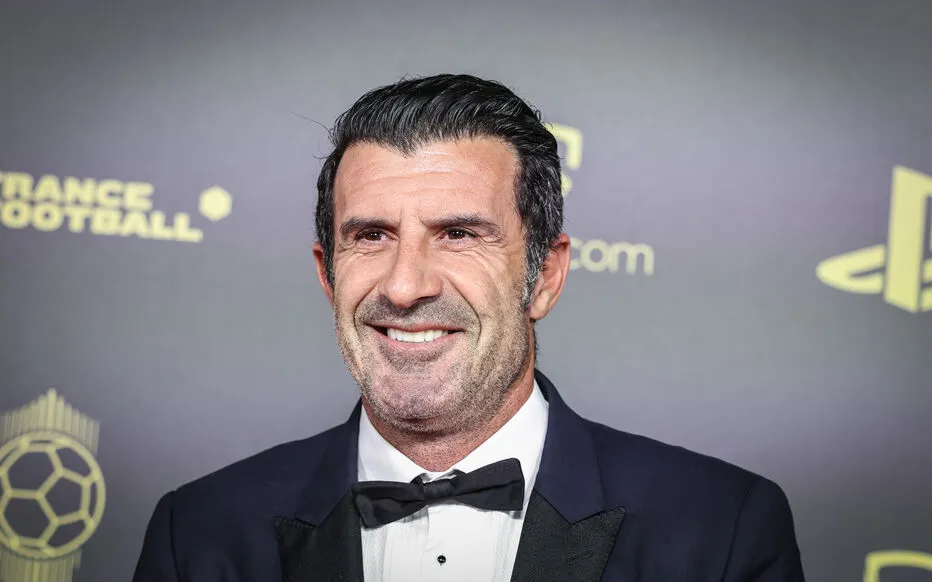
Luis Figo is a legendary Portuguese professional footballer who played as a winger for Sporting CP, Barcelona, Real Madrid, and Inter Milan. Known for his quickness, elegance, and skill, Figo was at some of his best in one-on-one situations, often beating his defenders with feints and stepovers.
He is also known for his leadership skills and the ability to create goal-scoring opportunities, which earned him a total of 106 assists in La Liga, a record only beaten by Lionel Messi.
Therefore, this is a biography of the legendary footballer who is regarded as one of the greatest of his generation.
Luis Figo’s Biography

Luís Filipe Madeira Caeiro Figo was born on November 4, 1972, and grew up in the working-class district of Cova da Piedade, Almada, Portugal.
He was a street footballer at U.F.C. Os Pastilhas, before joining the academy of Sporting Clube de Portugal (Sporting Lisbon) at the age of 12. He also played futsal and developed a lot of skills that served him throughout his football career.
Luis Figo’s Career

Figo began his football career at Sporting CP, where he made his league football debut on April 1, 1990, as a substitute for Marlon Brandão in a 1–0 home win against Marítimo. He scored his first goal against Torreense in the 1991–92 season, where he equalised in Sporting’s 2-1 win.
He won the 1991 FIFA Under-20 World Championships and Under-16 European Championships with Portugal’s junior sides alongside Rui Costa and João Pinto. In the same year, he earned his first international cap at the senior level.
After winning the 1994–95 Portuguese Cup with Sporting, Figo moved to Barcelona where his football career took off. Before moving to Barca, he had signed contracts with Italian clubs Juventus and Parma, leading to a dispute that saw him getting banned for two years. At Barca, Figo won the 1996–97 UEFA Cup Winners’ Cup, starring alongside Ronaldo. He was also part of a formidable attack that included Rivaldo and Patrick Kluivert. In total, Figo appeared 172 times for Barcelona, scoring 30 goals.
In July 2000, Figo made an unbelievable move to Barca’s eternal rival, Real Madrid for a fee of €62 million. It was a new world record fee at the time and signaled the beginning of the Galáctico era of the Real Madrid President, Florentino Pérez, signing global stars to the club every year. Figo’s move to Los Blancos left Barca’s fans feeling backstabbed and it became the new focus of the Barcelona–Real Madrid feud.
Despite the hostility from his former club’s fans, Figo went ahead to win the Ballon d’Or award in November 2000, mostly due to his exploits at Barca where he was the world’s best. On his return to Camp Nou in the iconic white Real Madrid shirt, there was a deafening noise with banners hung around the stadium with several captions like “Traitor”, “Judas”, “Scum” and “Mercenary”.
Shocked by the noise, Figo had to put his fingers to his ears and he was pelted with insults and flying missiles, such as oranges, bottles, cigarette lighters and mobile phones, anytime he got the ball. A regular corner kick taker, Figo did not take any for Madrid that day and the team lost 2-0 to Barcelona. After the match, Pérez stated that “the atmosphere got to us all”.
Figo would go ahead and win the 2001 La Liga title, scoring 14 goals in all competitions in his first season at Madrid. He also won the 2001 FIFA World Player of the Year and would later be joined at the club by Zinedine Zidane, Ronaldo De Lima and David Beckham. However, the hostility from Barca fans persisted as they would throw beer cans, lighters, bottles and golf balls at him anytime he went within their range.
In his second game back at Camp Nou on November 23, 2002, Madrid won a corner kick which Figo decided to take. But every time he began to run up to take the corner, a missile would be thrown at him. Eventually, the referee decided to pause the game for 20 minutes. During the break, a pig’s head, which became the defining image of the bitter rivalry, was spotted among the debris near the corner flag.
Figo would spend five seasons with Real Madrid, during which he won the 2001–02 UEFA Champions League and the 2003 La Liga title. He was named a member of the “Best Foreign Eleven in Real Madrid’s history”, according to Marca.
In 2005, Figo left Real Madrid and joined Inter Milan on a free transfer. He won the Serie A in each of his four seasons with Inter. The same day Inter won the 2008–09 title, Figo announced his retirement from football. He was on the sidelines when Inter won the 2009–10 UEFA Champions League on May 22, 2010.
International Career

As the leader of Portugal’s “Golden Generation”, Figo won a FIFA World Youth Championship in 1991. He scored three goals in eight qualifying games for UEFA Euro 1996, helping his country secure the Euro ticket for the first time in 12 years. Portugal later finished in the quarterfinals during the tournament.
At the Euro 2000, Figo led Portugal to the semi-finals, where they lost 2-1. He also helped the team qualify for the 2002 FIFA World Cup where they were eliminated in the group stages. However, the team bounced back during the 2004 Euros but lost 0-1 to Greece in the final.
Figo also captained the Portugal squad during the 2006 World Cup, leading the team to the semi-finals. However, they lost the third-place finish to the hosts, Germany. This was also Figo’s final appearance for Portugal which he ended on a high note after he assisted Nuno Gomes’ consolation goal.
In total, Figo finished his international career with 127 caps and 32 goals. He held the record for most appearances for Portugal national team until 2016 and he is also Portugal’s fourth-highest all-time goalscorer.
Following his retirement in 2009, Figo focused on football leadership. In 2017, he became the football advisor to UEFA. He’s also part of the UEFA ambassadorial programme.
Luis Figo Stats
According to Transfermarkt, Luis Figo had a total of:
Club football: 792 matches, 137 goals
National team (Portugal): 127 matches, 32 goals.
Check out the detailed statistics at Transfermarkt.
Luis Figo’s Net Worth
Figo has an estimated net worth of $50 million, according to Celebrity Net Worth.
Luis Figo’s Family

Figo is the only child of António Caeiro Figo and Maria Joana Pestana Madeira. He is married to a Swedish model, Helen Svedin. The couple has three daughters together: Daniela (1999), Martina (2002), and Stella (2004).
Luis Figo’s Age
Figo is currently 54 years old as of 2026.
Luis Figo’s Instagram
Luis Figo has an active Instagram account where he posts content about his lifestyle and career. His account has 5.4 million followers as of the time of writing this article.