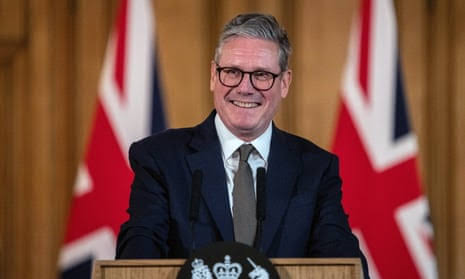
In July 2024, Sir Keir Starmer led the Labour Party to a landslide victory and subsequently became the Prime Minister of the United Kingdom. Before becoming the PM, Starmer, a barrister, was known for his controversial views, especially on the UK economy. He inspired the term “Starmerism” due to his ideology and his supporters are called Starmerites.
Here is a detailed biography of the UK’s former Prime Minister.
Keir Starmer biography

Sir Keir Starmer was born on September 2, 1962, in Southwark, situated in the British capital, London. However, he grew up in Oxted, Surrey. His parents, who were Labour Party supporters, named him after the party’s first parliamentary leader, Keir Hardie. Starmer himself has since clarified that did not know whether this was true.
READ ALSO: Shannen Doherty: Iconic Actress Who Lost Her Life To Cancer
He was enrolled into Reigate Grammar School, then a voluntary aided selective grammar school. In 1976, the school was converted to a fee-paying private school. This meant his parents had to pay for his education until he was 16 years old when he was awarded a bursary that allowed him to complete his education there without any parental contribution. Some of his classmates included musician Norman Cook (Fatboy Slim), Conservative Party leader Andrew Cooper, and conservative journalist Andrew Sullivan.
Starmer studied Law at the University of Leeds, becoming a member of the university’s Labour Club. He graduated with first-class honours and a Bachelor of Laws (LLB) degree in 1985. He was the first member of his family to graduate from a university.
The young Starmer also enrolled for postgraduate studies at St Edmund Hall, Oxford, graduating from the University of Oxford with a Bachelor of Civil Law (BCL) in 1986.
Keir Starmer career

Starmer joined UK politics when he was 16 years old, being a member of the Labour Party Young Socialists. Before he turned 18, he was a junior exhibitioner at the Guildhall School of Music and Drama where he played the flute, piano, recorder and violin.
After graduating from Oxford, Starmer served as the editor of Socialist Alternatives, a Trotskyist radical magazine which later established the British section of the International Revolutionary Marxist Tendency (IRMT).
In 1987, Starmer was named a barrister at the Middle Temple, where he later became a bencher until 2009. He was also a member of Doughty Street Chambers from 1990, primarily working on human rights issues.
In addition, Starmer was called to the bar in several Caribbean countries, defending convicts sentenced to the death penalty. On April 9, 2002, he was appointed Queen’s Counsel despite being known for proposing the abolition of monarchy in the UK.
Starmer also served as a human rights adviser to the Northern Ireland Policing Board and the Association of Chief Police Officers. He was a member of the Foreign, Commonwealth and Development Office‘s death penalty advisory panel from 2002 to 2008. He was part of a legal team that got Uganda’s Constitutional Court to invalidate the sentences of all 417 people on death row.
In July 2008, he was named head of the Crown Prosecution Service (CPS) and Director of Public Prosecutions, a position he held until November 2013. During this period, he oversaw the first British prosecution of al-Qaeda terrorists and brought charges against Tory and Labour politicians caught in an expenses scandal.
Keir Starmer politics

In December 2014, Starmer was elected to be the Labour parliamentary candidate for the Labour UK constituency of Holborn and St. Pancras, following the decision of Frank Dobson to retire. He was elected during the 2015 General Elections and has gone ahead to serve three more tenures.
Starmer also served as a “shadow minister” in the opposition, having the responsibility of negotiating the party’s position on Brexit. The now-PM did not want Brexit. Hence, the party’s shaky position on the referendum led to its colossal defeat in the 2019 General Elections.
As a result, the then Labour Party leader, Jeremy Corbyn, stepped aside and Starmer assumed the position as the leader of the Labour Party. He was credited for purging the party of members who had contributed to the public sense that Labour had “an antisemitism problem”.
In July 2024, his party emerged victorious by getting a landslide in the UK General election. As a result of the majority win of his party, Starmer was elected as the Prime Minister of the UK. He became the first Labour Prime Minister since Gordon Brown and the first to win a general election since Tony Blair. In his manifesto, the new PM pledged to promote economic growth, plan system reforms, infrastructure described as “clean energy”, healthcare, education and childcare, as well as strengthen workers’ rights.
One of his first acts as PM was to declare the Rwanda asylum plan dead and his appointed Home Secretary, Yvette Cooper, started the first steps towards establishing a Border Security Command. Starmer also pledged to give votes to 16-year-olds, reform the House of Lords and tax private schools, with money generated going into improving state education.
On July 5, 2024, he appointed his cabinet ministers, with women making a record half of the cabinet. They include Rachel Reeves as the first female Chancellor of the Exchequer in British history, and Angela Rayner as his Deputy Prime Minister.
Starmer announced his resignation in June 2026, less than two years after Labour’s 2024 general-election victory. His departure followed a period of mounting political difficulties, including falling public support and growing dissatisfaction with his leadership. His government had introduced a number of policies on workers’ rights, public services and social welfare, but critics increasingly portrayed his leadership as cautious and disconnected from voters.
Starmer’s resignation also came amid broader problems for the Labour Party. The party suffered significant electoral setbacks in the 2025 and 2026 local elections, while Starmer faced criticism over his political direction and handling of controversial issues. His leadership was also affected by the fallout from the Peter Mandelson scandal, which created further pressure around his judgement and government. Although Starmer had led Labour to a large parliamentary majority in 2024, his popularity deteriorated significantly during his time in Downing Street.
Following Starmer’s departure, Andy Burnham, the former Mayor of Greater Manchester, emerged as his successor and became UK prime minister. Burnham has sought to distinguish his government from Starmer’s by placing greater emphasis on regional devolution, public services and a more interventionist approach to the economy.
Starmer’s departure also triggered a by-election in his former Holborn and St Pancras constituency, where Labour is facing a challenge from the Green Party.
Keir Starmer net worth
According to Prolific London, Starmer has a net worth of around £7.7 million. However, the publication claimed the net worth can increase to between £10 million and £15 million when “taking his other revenue streams into account and the land he has held since 1996”.
Keir Starmer family

Starmer is the second of the four children of Josephine (née Baker), a nurse, and Rodney Starmer, a toolmaker.
He met Victoria Alexander, a solicitor, in the early 2000s while he was a senior barrister with Doughty Street Chambers. They worked on a case together. In 2004, the couple was engaged and got married on May 6, 2007, at the Fennes Estate in Essex. They have two children together – a son and a daughter.
Although Starmer is an atheist, his children were raised in his wife’s Jewish religion. In an interview during the 2024 General Elections, Starmer admitted he feared becoming a Prime Minister would have an impact on his children due to their “difficult ages” and how it would be easier if they were younger or older. He also said he would try to stop working after 6 pm so he would spend more time with his family.
Keir Starmer age
Starmer will be 64 years old in September 2024.
Keir Starmer Instagram
Keir Starmer has an active Instagram account where he posts content on his work. His account has about 850,000 followers as of the time of writing this article.